GUITAR GUIDE 007 · GUITAR BASICS
Nut & Saddle: The Two Ends of the String
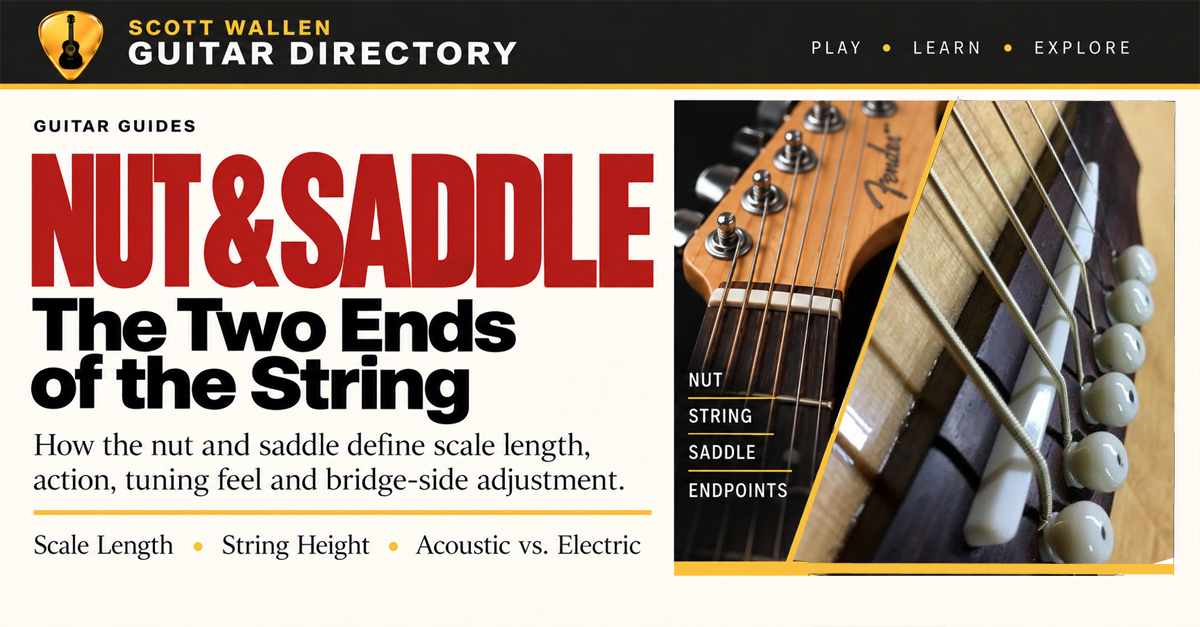
The nut and saddle are small parts, but together they establish the working ends of an open guitar string. Between them lie the frets, the scale length and much of what a player experiences as action, tuning behavior and intonation.
FROM RAINS
N is for Nut. S is for Saddle.
In the RAINS memory aid, the nut and saddle are taught together because they make a natural pair. On most guitars, the open string vibrates between the nut at the headstock end and the saddle at the bridge end.
Why pair them? The nut strongly influences string spacing and first-fret feel. The saddle strongly influences bridge-side action and compensation. Together they help define how the string behaves across the neck.
SCALE LENGTH
The distance between the two
Scale length is the nominal vibrating length of the string. A practical way to establish it is to measure from the nut to the center of the 12th fret and double that measurement.
Guitars do not all use the same scale length. Common nominal examples include roughly 24.75, 25 and 25.5 inches, along with many other designs. The measurement is part of the instrument's geometry—not a universal guitar specification.
The actual saddle contact point is normally compensated slightly beyond the purely mathematical scale-length position. That added distance helps account for the small increase in tension created when a player presses a string down to a fret.
Important distinction: Scale length gives the nominal measurement. Compensation explains why the saddle contact points usually do not sit in one perfectly straight line at exactly that distance.
N · THE NUT
Spacing, first-fret height and smooth string movement
The nut sits at the headstock end of the fingerboard. Its slots guide the strings into position and help determine how high each string sits above the first few frets.
- String spacing. The nut establishes the side-to-side position of the strings near the headstock end of the neck.
- Nut-slot height. Slots that are too high can make first-position chords unnecessarily hard to fret and may pull notes sharp. Slots that are too low can allow open strings to buzz.
- Slot width and shape. Each string needs a slot that supports it while still allowing smooth movement during tuning and bending.
- Tuning behavior. A string that binds in the nut can release suddenly with a ping and make smooth, predictable tuning more difficult.
Player clue: If first-position chords feel much harder than the rest of the neck, or a string catches and jumps while tuning, the nut deserves attention.
S · THE SADDLE
Action, compensation and the bridge-side endpoint
The saddle is the point where the vibrating string meets the bridge. Its height affects action, and its position helps establish the compensated string length needed for accurate intonation.
- Saddle height. Changing the bridge-side string height changes action across much of the neck.
- Saddle position. Moving the contact point forward or backward changes the effective string length and therefore the intonation.
- String break point. The top of the saddle gives the string a defined contact point before it continues toward the bridge or tailpiece.
- Acoustic energy transfer. On an acoustic guitar, the saddle also participates directly in transferring string vibration into the bridge and soundboard.
Player clue: When bridge-side action or intonation is being discussed, the saddle is usually part of the setup conversation.
SAME TERMS, DIFFERENT HARDWARE
Acoustic and electric guitars solve the same problems differently
Same physics—different hardware. Both types of guitar need controlled string height and accurate string length. The available adjustment methods are not the same.
SETUP JOBS INVOLVING THE NUT
Small changes at the first fret can be easy to feel
A full setup may involve the nut in several ways. Not every guitar needs all of these operations, and some require specialized files and careful measurement.
- Checking nut-slot height. Determines whether the strings sit appropriately above the first frets.
- Correcting slot width or shape. Helps the string move smoothly without excessive looseness or binding.
- Checking string spacing and alignment. Confirms that the strings sit comfortably across the fingerboard.
- Cleaning or lubricating problem slots. May help strings move more smoothly where appropriate.
- Replacing a poorly fitted or damaged nut. Used when adjustment alone cannot correct the problem.
Why technicians move carefully: A nut slot can be lowered easily with a file. Putting material back after cutting it too deeply is a different problem.
SETUP JOBS INVOLVING THE SADDLE
The work depends heavily on the bridge design
Electric and acoustic saddles often participate in the same setup goals—action and intonation—but the method of adjustment can be very different.
- Electric saddle height. Individual saddle screws or bridge adjustments may be used to set string height and follow the fingerboard radius.
- Electric intonation. Saddles are commonly moved toward or away from the nut to correct sharp or flat fretted notes.
- Acoustic saddle height. Action is often changed by fitting, reshaping or replacing the saddle rather than turning an adjustment screw.
- Acoustic compensation. The saddle's angle and contact shape help different strings reach a workable compensated length.
- Acoustic saddle fit. A properly seated saddle matters structurally and can also matter for consistent contact with an undersaddle pickup when one is used.
Electric adjustment is often reversible. Acoustic material removal may not be. That difference is one reason acoustic saddle work is commonly approached more conservatively.
HOW THIS CONNECTS TO ACTION & INTONATION
The endpoints do not work in isolation
Nut height, saddle height, neck relief and fret condition interact. A player may experience the result simply as “high action” or “buzz,” but the cause can occur in different parts of the instrument.
Intonation adds another connection: the saddle is used to fine-tune the effective string length after the guitar's other basic setup conditions are established.
Related guide: Understanding Guitar Intonation →
WHAT A BUYER CAN CHECK
Observe first. Modify nothing.
A buyer does not need nut files or setup tools to learn something useful. Several simple observations can reveal whether the nut or saddle deserves a closer professional look.
- Play open strings individually. Listen for buzzing, sitar-like noise or obvious binding during tuning.
- Play first-position chords. Notice whether the guitar feels unexpectedly stiff close to the nut.
- Look at the saddle. Check for obvious leaning, damage, extreme height or unusually little saddle remaining above an acoustic bridge.
- Check tuning farther up the neck. A guitar that tunes open but sounds progressively wrong higher up may need intonation or broader setup attention.
- Ask what work has already been done. Nut replacement, saddle lowering or bridge work can be useful history when evaluating a used instrument.
Inspection is not diagnosis. The goal is to recognize clues and ask better questions before buying or changing the instrument.
RELATED RAINS GUIDES
The string's endpoints connect the setup system
DIRECTORY POSITION
Two small parts explain a surprising amount of the guitar
The nut and saddle give a beginner a useful way to visualize the instrument as a system. They define the ends of the open vibrating string, connect directly to scale length and help explain action, tuning behavior and intonation.
Once those relationships are understood, phrases such as “the nut slots are high,” “the saddle is low,” “the scale is 25.5 inches” or “the saddles need more intonation travel” stop sounding like disconnected repair-shop vocabulary.
SUPPORTING PERSPECTIVES
Same job. Different hardware.
Acoustic and electric guitars use the nut and saddle to solve many of the same setup problems, but the hardware—and the way adjustments are made—can be very different. These two demonstrations show both sides of that conversation.
Sweetwater · Acoustic Guitar Setup A professional acoustic setup showing how nut-slot height and saddle height affect playability, action and tuning behavior.
Why the Guitar Nut Matters A concise explanation of how the nut affects string spacing, first-fret clearance, buzzing, tuning stability, intonation, tone and sustain.
Sweetwater and Fender are credited as the sources of the supporting material above. Their inclusion is for educational commentary and reference and does not imply sponsorship, affiliation or endorsement of GuitarSearch.org.
Back to the five setup words: RAINS: Relief, Action, Intonation, Nut and Saddle →